Shroom: the desktop tool that turns frames into a dataset.
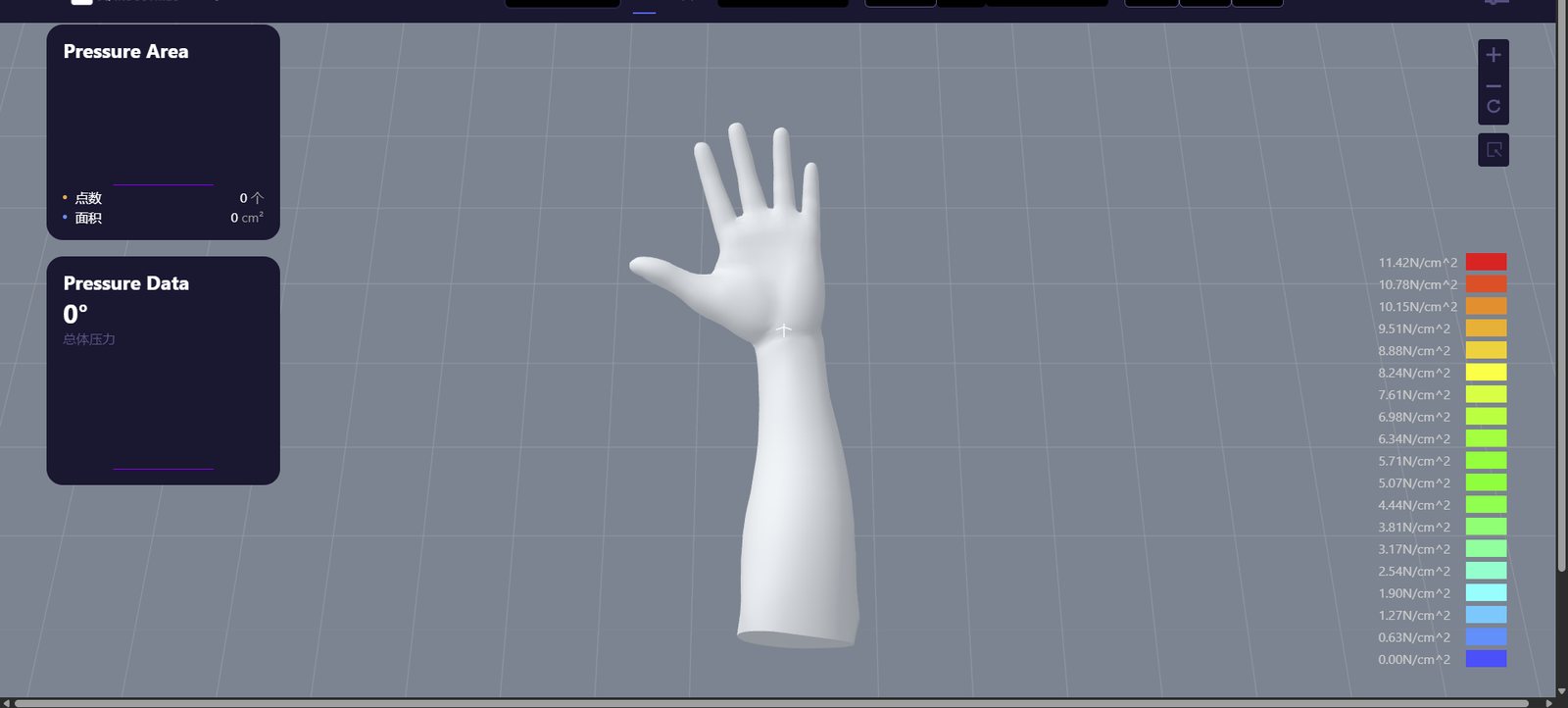
Pressure field on a body model, a raw matrix when you want the numbers, record and replay, CSV out. The stream stays open, the software is a convenience, not a gate.
What Shroom does: five functions, no more
The tool is small on purpose: anything that belongs in your pipeline is left to your pipeline.
| Function | Detail | Why it exists | Can you replace it? |
|---|---|---|---|
| Display3D body, 2D matrix | Pressure colour scale over the shell geometry | You cannot debug a seam by reading hex | Yes, cells are cells |
| Record / replaysession files | Capture and step back through a session | Regressions show up in replay, not in logs | Yes |
| Zone masksper part | Select the region you care about | Peak load over a whole torso hides the contact | Arithmetic on cells |
| Load readoutsarea, total, centroid | Pressure area, summed load, contact centroid | Fast sanity check before a full export | Arithmetic on cells |
| CSV exportper frame | Timestamp, part id, cell values | The handoff into Python, ROS or a dataset | Yes, the format is open |
No SDK, no cloud, no lock-in
If the software disappeared tomorrow, your hardware would still stream and your datasets would still open, that is the design constraint.
There is no vendor API to build against, no cloud account, and no format only the application can open: sessions and exports are plain files. The trade is convenience for portability, you write your own episode converter rather than calling ours. For labs already running ROS 2 and a LeRobot pipeline, that trade is the right one; for a demo bench that needs a pressure picture on screen in an afternoon, the application earns its seat.
Licensing: per workstation, per year
Seat pricing is honest about how robotics labs buy software: by bench, not by robot.
A seat is one workstation, licenced annually, checked online at start. Two robots driven from one PC is one seat. The check needs internet and does not pass through a VPN; if that rules your lab out, say so before the order, an air-gapped site is a conversation, not a checkbox. Installers are signed for Windows and macOS; there is no Linux build, because on Linux the stream is what you want anyway.
The data path, in four steps
One hop of convenience, then out of the way.
Fabric cells, 8-bit, ≤2.33 mm
921,600 bps, 0xAA 0x55 0x03 0x99
Display, record, zone masks, CSV
Your schema: LeRobot, HDF5, parquet
Questions specific to this page
Which operating systems?
Windows and macOS builds, both installed from a signed package. There is no Linux build; on Linux the raw stream is yours to read, which is usually the point.
Can one licence drive several robots?
One seat is one workstation. A bench running two robots from one PC is still one seat; two PCs are two. Say how many stations record simultaneously and the quote is built on that.
What exactly does the CSV contain?
One row per frame: timestamp, part identifier, and the cell values for that part, so a session can be filtered by limb. The quaternion travels alongside, not merged into the cell rows.
Is there an API?
No vendor API, by design. The stream is the API. Anything the application does, display, zone masks, load totals, is arithmetic on cells you already have.
RelatedOther parts of the set
QuoteTell us the platform and what you want from the software side.
No list price: a pilot set and a fleet order are different builds, and a number printed on a page would mislead on both. Send the robot, the coverage, pilot or volume, and the timeline.
[email protected]- Manufacturing
- HaptiData
- Supply & integration
- HaptiData, outside mainland China
- Warranty
- One year limited, from delivery